
When Kickoff Tactics first appeared on the mobile gaming scene, the comparisons were instant and inevitable: “It’s just Marvel Snap with footballers.” And honestly, at first glance, it’s hard to argue. Three zones. Two players. Cards with costs and power values. A collection track. A season pass. The DNA is unmistakable.
But spend a few hours with both games and a more interesting picture emerges. Kickoff Tactics isn’t just a straight carbon copy, it’s a football-flavoured take on a brilliant formula, with some genuinely clever twists that make it its own game. Let’s break down exactly where these two titles align, where they diverge, and what that means for fans of either.
The Foundation: What They Share
Three-Zone, Best-of-Three Control

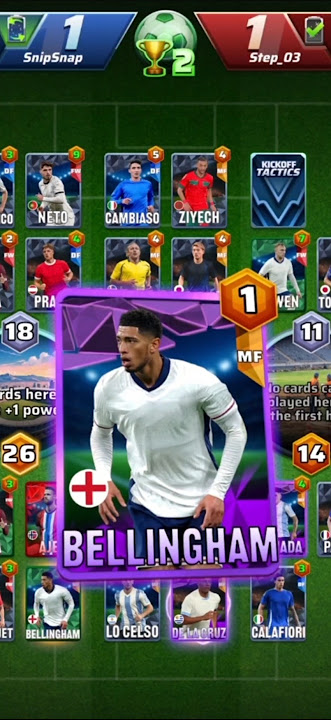
Both games are built on the same elegant core: a board divided into three Zones (or locations, in Snap’s terminology), and a simple win condition: control more of them than your opponent when the final whistle blows.
In Marvel Snap, after six turns, whoever has more power at two out of three locations wins. If one location is tied, the player with the greatest power advantage at the other locations takes the game.
Kickoff Tactics mirrors this exactly. The field is divided into three distinct zones, each representing a key area of play, and your goal is to score more goals than your opponent by controlling those zones.
Both games reward players who can think across the whole board rather than overcommitting to a single zone, a strategic principle that feels just as at home on a football pitch as it does in the Marvel universe.
Cards with Cost and Power


The card anatomy is virtually identical. Every card has an energy cost (how much it costs to play) and a power value (how much it contributes to your zone). You start a game with one energy on turn one and gain an additional energy at the start of each turn, with no limit to the number of cards you can play in a given turn – just the energy available to you.
Kickoff Tactics follows the same rhythm. At the start of each round, you gain energy. Round 1 = 1 energy, Round 2 = 2 energy, and so on, and unspent energy does not carry over to the next turn.
This creates a satisfying tactical escalation in both games as each round opens up more options and bigger plays.
Card Abilities and Keywords


Both games layer special abilities on top of the base cost/power system. In Marvel Snap, cards have On Reveal effects (which trigger when a card is flipped) and Ongoing effects (which persist while the card remains in play). On Reveal effects activate only once when the card is flipped face-up at the end of the turn. Ongoing effects are passive and persist as long as the card remains on the field.
Kickoff Tactics uses a parallel structure. Cards have On Appear effects (which activate instantly when revealed), Active effects (which stay in play as long as the card is on the field), Non-Specified abilities that trigger under certain conditions, and Base Cards with no special ability, just raw stats.
If you’ve learned to navigate Marvel Snap’s ability system, Kickoff Tactics’ version will feel immediately familiar.
Simultaneous Turns
In both games, you and your opponent play your cards at the same time, with reveals happening at the end of each round. Turns happen simultaneously, so you won’t know what your opponent is playing until after you have made your play and ended your turn. This keeps every round tense and means you’re always playing with incomplete information, a key reason both games feel so replayable.
The Collection Track


Both games tie card upgrades to a collection track that rewards progression. In Marvel Snap, to advance the Collection Level, you must upgrade the cosmetic rarity of your cards by spending Credits and card-specific Boosters. The upgrades themselves are purely cosmetic, an upgraded card has no mechanical advantage over its base version.
Kickoff Tactics is identical in philosophy. Upgrade output is purely visual – there is no effect on the cost or power of the upgraded card. As you upgrade cards, your Collection Level increases, unlocking even more rewards and players.
In both cases, the grind is real, but the game is careful to ensure that spending money on cosmetics never gives a competitive edge.
Daily Missions and the Season Pass


Both games use the same engagement loop to keep you logging in: daily missions to earn resources, and a monthly premium pass for extra rewards.
In Marvel Snap, every eight hours you receive two Daily Missions that reward Credits – easier ones give 50 Credits, harder ones give 100 – and they also reward Season Pass XP.
The Season Pass model is nearly identical too. Each season in Marvel Snap introduces a special card for premium users who purchase the Season Pass, which also grants extra Gold, Credits, and cosmetics for around $10.
Kickoff Tactics follows the same blueprint with its own monthly Collectors Pass, offering new cards and resources to paying players.
Rush / Snap: The Stakes-Doubling Mechanic

Both games include a mechanic that lets a confident player raise the stakes mid-match. In Marvel Snap, the Snap mechanic allows you to essentially gamble your ranked points when fighting another player, and you can use it as a bluff or as a counter to an opponent’s own Snap.
Kickoff Tactics calls this Rush, and the logic is the same. If you’re confident in your win, pressing the Rush button doubles the number of trophies you’ll earn, but losing means double the loss. Neither game forces you into it, and both reward the psychological read as much as the mechanical one.
Where Kickoff Tactics Does Its Own Thing
Eight Rounds Instead of Six… and a Half-Time
This is the biggest structural difference. Marvel Snap plays out over six turns. Kickoff Tactics stretches to eight, and crucially, those eight rounds are split into two halves.
Matches are decided in Round 4 and Round 8. At these key moments, each player scores one goal for every zone they control. The player with the most goals at the end of the match wins.
This “first half / second half” structure changes the strategic texture of the game significantly. In Marvel Snap, you’re building towards one decisive endstate. In Kickoff Tactics, you’re playing two mini-games within a match. A player can go 1-0 down at half-time and still win the match, which adds a comeback dynamic that Snap simply doesn’t have.
The Tactics System: A Half-Time Boost
The half-time break introduces another mechanic that has no equivalent in Marvel Snap: Tactics.
At the end of Round 4, right before the second half begins, both players are presented with a Tactic – a special mid-match decision. Each player selects one effect from a random set of three options, which is then applied during the second half (Rounds 5 to 8). Tactic effects vary in nature: some provide continuous passive bonuses, others trigger once under specific conditions, and certain effects may require an activation such as playing a card of a specific type.
Players can also use a one-time reroll to draw three new tactic options, but at a cost: you’ll start Round 5 with 1 less energy than usual.
This is a genuinely novel addition. It introduces a layer of mid-match adaptation that Snap doesn’t have, and it means the second half of every Kickoff Tactics game can play out very differently from the first. It also rewards players who can evaluate three random options quickly and identify which synergises best with their deck and current board state.
Deck Building: Squads vs. Decks


Before a single card is played, the two games approach deck construction very differently, and it’s one of the first things a Marvel Snap veteran will notice when they pick up Kickoff Tactics.
In Marvel Snap, the deck-building rules are deliberately minimal. Each deck contains exactly 12 cards, with no duplicates permitted. That’s the only constraint. You pick 12 cards, no positions, no formations, no structure, just a flat list of characters that you believe will work well together. It’s clean, fast, and low-friction, which is a big part of why Snap is so accessible to newcomers.
Kickoff Tactics asks considerably more of you before kick-off. Your deck is a 15-card squad that mirrors a real football lineup: 11 starters and 4 substitutes. The 11 starters must be arranged into a valid football formation (a 4-3-3, a 4-4-2, a 5-3-2, and so on) with each card slotted into the appropriate positional role of Goalkeeper, Defender, Midfielder, or Forward. This isn’t just flavour. The formation you choose shapes the positional balance of your deck and influences how your cards enter the game. The four substitutes are added into the deck progressively during Rounds 3 to 6 – one card per round – and must include 1 Forward, 1 Midfielder, 1 Defender, and 1 wildcard. This means your substitutes arrive in a fixed order and at fixed moments, so you need to plan for when each one lands, not just whether they fit the strategy.
The practical result is that Kickoff Tactics’ deck builder has a higher upfront cognitive load than Snap’s, but it rewards that investment with a richer strategic layer. Choosing your substitutes isn’t a secondary consideration. A well-timed sub arriving in the later rounds can be the tactical masterstroke that wins the second half. For football fans, the whole system will feel instinctive. For Snap players coming in fresh, it’s the steepest part of the learning curve.
Football-Specific Card Mechanics
Kickoff Tactics introduces some card skills that are rooted in football logic and have no Snap equivalent:
- Marking — prevents a marked player card from gaining power-ups, as long as both cards remain in the same zone (a direct nod to man-marking tactics)
- Booking — two yellow cards equals a red card, causing the player to lose their in-game abilities (as true to the beautiful game as it gets)
These aren’t just cosmetic flavour. Marking in particular introduces a counter-play dynamic against high-power ability cards that Snap’s mechanic vocabulary doesn’t quite replicate.
No Variants: What You See Is What You Get

One notable absence in Kickoff Tactics is Marvel Snap’s variant system. In Snap, each card has multiple cosmetic variants, alternate artwork versions that can be upgraded separately and purchased with Gold or earned through the Collection Level track. Chasing rare variants is a significant part of Snap’s long-term engagement loop and, for many players, a major spending driver.
Kickoff Tactics currently doesn’t have this system. Cards have one look, and there’s no alternate art to chase, no variant shop, no daily cosmetic offers. Whether this is a missed monetisation opportunity or a refreshingly clean approach to collection will depend on your perspective, but it does mean the economies of the two games feel quite different. In Snap, Gold flows into cosmetic variant purchases as much as anything else; in Kickoff Tactics, the resource loop is more straightforwardly tied to the collection track.
The Verdict: Inspired By, Not a Copy Of
It would be intellectually dishonest to pretend Kickoff Tactics wasn’t designed with Marvel Snap as a reference point – the structural similarities are too numerous and too precise to be coincidental. But “inspired by” is very different from “a copy of.”
The half-time structure, the Tactics system, the football-specific mechanics like Booking and Marking, and the substitute progression system all give Kickoff Tactics a genuine identity. If Marvel Snap is a fast-paced superhero brawl decided in a single burst, Kickoff Tactics is a proper 90-minute encounter with two acts, a team talk at half-time, and substitutions that can swing the result.
For football fans who’ve bounced off Marvel Snap because the Marvel IP doesn’t resonate, Kickoff Tactics is an easy sell. And for Snap veterans, it’s familiar enough to learn in minutes, but different enough to keep you thinking.
The two games can absolutely coexist in your mobile rotation. They’re simply solving the same puzzle with different pieces.
Want to dive deeper into Kickoff Tactics? Sign up to check out our Player Database and Deck Builder to start building your perfect squad.